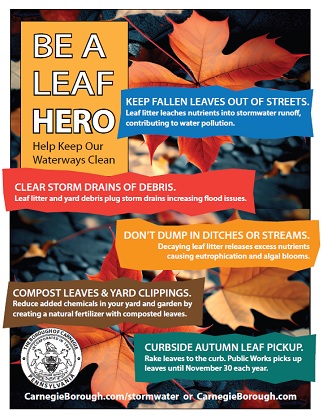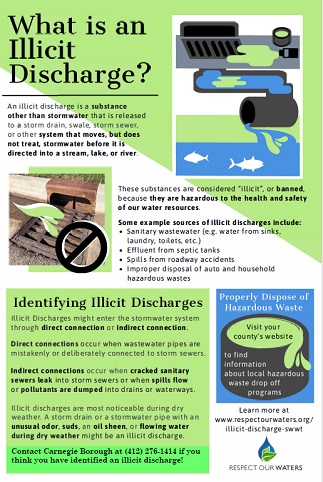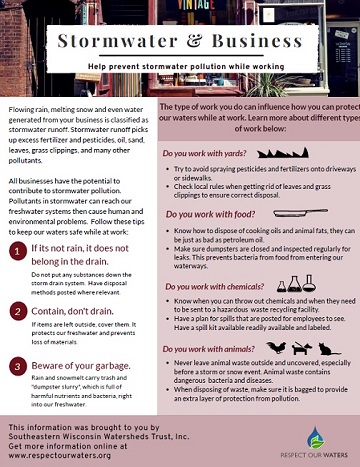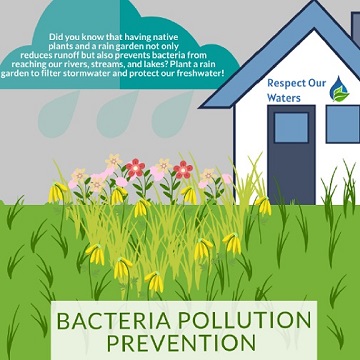
HOMEOWNERS
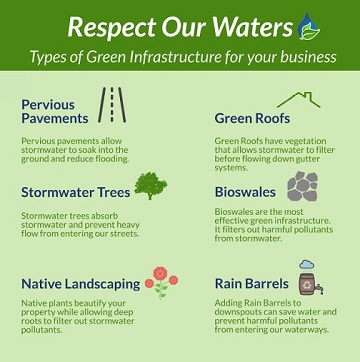
Modern stormwater management frequently includes the installation of "Best Management Practices" (BMPS). Urban stormwater BMPs involve a wide variety of techniques that reduce storm water pollution from developed areas. One thing that all BMPs have in common is that they need routine maintenance to perform properly. Since many BMPs are installed on private property, it is important that the owners be offered advice on BMP care.
Homeowners Guide to Stormwater BMP Maintenance - click here
This publication was developed under Assistance Agreement No CB-96317101-5 awarded by the U.S. Environmental Protection Agency (EPA), and administered by the Pennsylvania Department of Environmental Protection (DEP). The views expressed in this document are solely those of DEP. The mention of any product or commercial service in this publication does not constitute an endorsement by DEP or EPA.

________________________________________________________________________________________________________
BMP MANUAL
In undisturbed landscapes, rainwater runoff is part of the natural hydrologic cycle. Vegetation, soils, and a wide range of organisms filter, absorb, and use rainfall in their living processes. Evaporation and transpiration takes place. Excess precipitation infiltrates into groundwater and flows into surface waters, recharging aquifers and supporting aquatic life. The entire system is affected when the landscape is changed: impervious surfaces (paved streets, parking lots, rooftops, etc.) prevent runoff from percolating into the ground and cause it to pick up debris, sediments, chemicals, and other pollutants as it moves over the ground.
In order to assist municipalities, designers, developers, and engineers in understanding, developing, and implementing stormwater management programs, PA DEP published the PA Stormwater BMP Manual in 2006.
As noted in the Foreword:
"The Manual is intended to be a tool to achieve the regulatory standard to protect, maintain, and improve the Commonwealth's water resources through comprehensive site planning and BMP design guidance, while allowing for the continued growth and development of Pennsylvania."
As such, the Manual's main focus is on BMPs that help meet the requirements of MCMs 4 through 6. These BMPs are generally classified as "non-structural" (design and planning techniques that preserve natural systems and hydrologic functions on a site) and "structural" (more conventional 'brick and mortar' techniques, which may include vegetation and soil-based mechanisms.) The key distinction between Non-Structural and Structural BMPs is that the former are intended to prevent stormwater generation, while the focus of the latter is on mitigating unavoidable stormwater-related impacts.
When it comes to development, the Stormwater Management Program described in the Manual emphasizes a comprehensive total site design approach. Whether referred to as "Low Impact Development", "Conservation Design", or "Green Design", this environmentally sensitive approach to site development and stormwater management aims to minimize the effect of development on water, land, and air resources.
The use of best management practices, or BMPs, is the primary method of controlling stormwater discharges and preventing runoff from adversely affecting water quality. BMPs are a suite of planning processes, development methodologies, and specific techniques designed to be used in combination to:
- Prevent disturbances to natural systems and hydrologic functions; and
- Minimize the impacts of disturbances where they do occur.
This guidance Manual identifies information on resource planning, techniques for land development, and concepts and procedures for designing and implementing performance-based BMPs for managing stormwater for quantity and quality. The comprehensive planning approach to stormwater management emphasizes reducing the impacts of development activities through the mitigation process by employing practices that avoid and minimize potential impacts to watershed resources. The BMPs are designed to minimize or mitigate for the unavoidable impacts that development has on watershed resources.
This manual lists various BMPs and design standards, which are acceptable in Pennsylvania to manage stormwater and prevent pollution of waters of the Commonwealth. Stormwater management plans and the BMPs designed according to these standards when properly applied, implemented and maintained, will achieve the Department's water quality mandates established in 25 Pa. Code Chapter 93 and required by the federal Clean Water Act, federal NPDES regulations, the Pennsylvania Storm Water Management Act and the Pennsylvania Clean Streams Law. The proper utilization and implementation of these BMPs will protect and maintain existing uses and the level of water quality necessary to protect the existing uses, and will protect and maintain the water quality of high quality and exceptional value waters of the Commonwealth.
This Manual Provides:
- A standardized process for evaluating site design and BMP selection to minimize or eliminate the net change in post construction volume, rate and quality.
- A standardized approach to measuring pre-construction volume, rate and quality and post construction site runoff volume, rate and quality.
- Standardized specifications for BMPs to manage stormwater to minimize the net change in post construction runoff volume, rate and quality.
Alternate BMPs, not listed in this manual, that provide the same or greater level of protection, may also be used to attain the regulatory standard. It is incumbent on the person proposing the use of alternative BMPs to demonstrate their effectiveness with appropriate supporting analysis, calculations, test results or other documentation.
 BMP Manual - Introduction
SUMMARY: The Department will ensure that activities and plans approved under its authority will employ stormwater management plans utilizing best management practices to control the volume, rate and water quality of post construction stormwater runoff so as to protect and maintain the chemical, physical and biological properties of waters of the Commonwealth. These best management practices must, at a minimum, protect and maintain water resources, preserve water supplies, maintain stream base flows, preserve and restore the flood carrying capacity of waters, preserve to the maximum extent practicable the natural stormwater runoff regimes and natural course, current and cross section of waters of the Commonwealth, and protect and conserve ground waters and ground-water recharge areas.
Pennsylvania Stormwater Best Practices (BMP) Manual - Click Here
________________________________________________________________________________________________________
Manager's Resource Handout - Nine Minimum Controls (NMCs)
Integrating NMCs in Stormwater Plans into your community's stormwater strategy.
What to include in your plan:
- Operations & Maintenance - How often you will sweep streets and clean catch basins?
- Ordinances & code enforcement - What monitoring and penalties exist for erosion and for littering?
- Staff trainings & integration: involving as many departments in NMCs as possible - Go beyond Public Works. Think Law Enforcement, Zoning, etc.
- Public outreach & education methods - Do your residents know the relationship between their streets and their stormwater?
- Record-keeping & reporting process - Keep track of everything from street sweeping mileage, to community cleanups, to participation in shared services and anti-dumping programs (resources below).
Best Practices to Combat Illegal Dumping
- Instate a clear ordinance against littering and dumping.
- Increase enforcement by holding regular law enforcement trainings.
- Raise fines and ensure true accountability in court for violations.
- Communities should expect dumpers to pay the cost of cleanups, which can run up to $10,000 for a site.
- Place physical barriers near dump sites to discourage access.
- Trees, guardrails, and fencing are great options.
- Physical barriers should never hinder first responders from accessing properties.
- Install cameras to capture dumpers in the act.
- Install trash and ash receptables at "transition points" such as outside business doorways and at bus stops.
Other Litter Prevention and Enforcement
- Continue hosting collection events for hard-to-dispose or hard-to-recycle materials.
- Base methods on items frequently dumped and residents' transportation needs.
- Sponsor anti-litter campaigns and distribute education materials on littering impacts.
- Track you efforts and track collected waste.
- Many nonprofit partners will track collection data for you.
- Add these regular strategies to your stormwater plan at the outset.
________________________________________________________________________________________________________
EPA's NPDES Phase II Rule
requires those undertaking land-disturbing construction activities, operators of industrial facilities, and operators of small Municipal Separate Storm Sewer Systems (MS4s) to protect water resources. MS4 permits call for the development and implementation of a stormwater management program that addresses six "minimum control measures" (MCMs). Implementing these minimum control measures, typically means applying one or more best management practices (BMPs). Because of site-specific, local, and regional variability, the BMPs deemed most appropriate for one community may be vastly different for another community within the same watershed, let alone in a different part of the state, or a different part of the country!
EPA offers a variety of resources outlining the six MCM requirements, goals of each, and suggested BMPs that can help achieve results.
Minimum Control Measures
MCM 1: Public education & outreach Fact sheet
MCM 2: Public involvement & participation Fact sheet
MCM 3: Illicit discharge detection & elimination Fact sheet
MCM 4: Construction site runoff control Fact sheet
MCM 5: Post-construction stormwater management in new development & redevelopment Fact sheet
MCM 6: Pollution prevention & good housekeeping for municipal operations & maintenance Fact sheet
________________________________________________________________________________________________________
Watersheds of South Pittsburgh
Lisa Werder Brown, Executive Director lisa@econdevsouth.org
Ashley DiGregorio, Program Director ashley@econdevsouth.org
Keep Pennsylvania Beautiful
Litter Stand Initiative
https://www.keeppabeautiful.org
Cigarette Litter Prevention Program: rdubas@keeppabeautiful.org
Great American Cleanup: mdunn@keeppabeautiful.org
Register your cleanup events Mar 1-May 31
Pennsylvania Resources Council
Hard-to-Recycle Collection Events
Chemical, Cosmetics, and Rx Collections
E-Waste Collections
Reuse Fest
Zero-Waste Event Services & Backyard Composting Workshops
saraha@prc.org | www.prc.org
Illegal Dump Free PA
Allegheny CleanWays
DumpBusters
Tireless Project for riverfront communities
Cleanup "blitzes" Trash removal river barge
www.alleghenycountycleanways.org
Stormwater Websites
DEP Stormwater Website
DEP - Municipal Stormwater
PA Department of Environmental Protection
US Environmental Protection Agency
US Environmental Protection Agency - Stormwater
3 Rivers Wet Weather
Alerts
USGS Mobile or Email
WATER ALERT SUBSCRIPTION
Report a Problem
COGs: Program Breakdown
Street Sweeping:
North Hills & Steel Rivers
Catch Basin Vactor:
Char-West, North Hills, South Hills, Turtle Creek Valley
Equipment Sharing:
Allegheny Valley North, Char-West, North Hills, South Hills
Additional Services:
North Hills - Joint Leaf Composting
Steel Rivers - GIS Services
Landscaping with Native Plants
Educational Resources
Articles & Activities for Middle School Students
Darby Duck the Aquatic Crusader
Nonpoint Source Pollution Word Search Puzzle
Student Activity - What's Wrong with this Picture
EPA Stormwater Sticker Sheets for Kids
Take the Runoff Challenge - Crossword Puzzle
The Monsters of the Waterways
Brochures